


Customer service outsourcing is the practice of partnering with a specialized provider to manage some or all customer support operations, allowing businesses to improve service quality, scalability, and operational efficiency.
Depending on the model, an outsourcing partner may handle phone calls, live chat, email, social media, technical support, order management, and other customer interactions.
The goal isn’t simply to move customer service somewhere else. A well-designed outsourcing strategy gives companies access to trained teams, technology, management expertise, broader operating hours, and additional capacity without having to build every capability in-house.
For growing U.S. companies, the decision typically comes down to three questions: What should we outsource? Where should the team operate? And how should we pay for it?
How does customer service outsourcing work?
Most outsourcing programs follow five stages.
1. Define the scope
The company identifies which interactions will move to the provider.
Common examples include:
- Tier 1 customer support
- Inbound calls
- Email support
- Live chat
- Order status inquiries
- Appointment scheduling
- Technical support
- Social media support
- After-hours coverage
Companies do not need to outsource their entire customer journey. Many begin by outsourcing high-volume interactions while retaining complex or strategic functions in-house.
2. Select the operating model
Customer support can be delivered through:
Dedicated teams: Agents work primarily or exclusively for one client.
Shared teams: Agents support multiple programs, typically for lower-volume operations.
Hybrid teams: A dedicated core team is supplemented with flexible capacity.
Companies may also choose between onshore, nearshore, and offshore locations. For U.S. organizations, nearshore customer service outsourcing in Mexico can offer a middle ground between U.S.-based operations and distant offshore locations.
3. Transfer knowledge
The outsourcing company learns the client's:
- Products and services
- Brand guidelines
- Workflows
- Escalation rules
- CRM environment
- Knowledge base
- Compliance requirements
- Performance expectations
This phase often determines how closely an outsourced customer service team operates as a seamless extension of the internal organization.
4. Launch and manage operations
Once agents are trained, the outsourcing provider manages day-to-day operations such as workforce scheduling, coaching, quality monitoring and staffing.
More mature programs also connect customer conversations with analytics. For example, Pentafon's CX Technology solutions incorporate speech and text analytics, AI, automation and omnichannel technology directly into customer experience operations.
5. Measure performance
Successful outsourcing programs are measured by business outcomes rather than agent activity alone.
Common KPIs include:
What customer service functions can be outsourced?
Nearly every high-volume support channel can be outsourced. Pentafon's customer service solutions, for example, include inbound and outbound customer service, chat, web, social media, text, order-taking and Tier 1 technical support.
The right scope depends on complexity. A useful rule of thumb is:
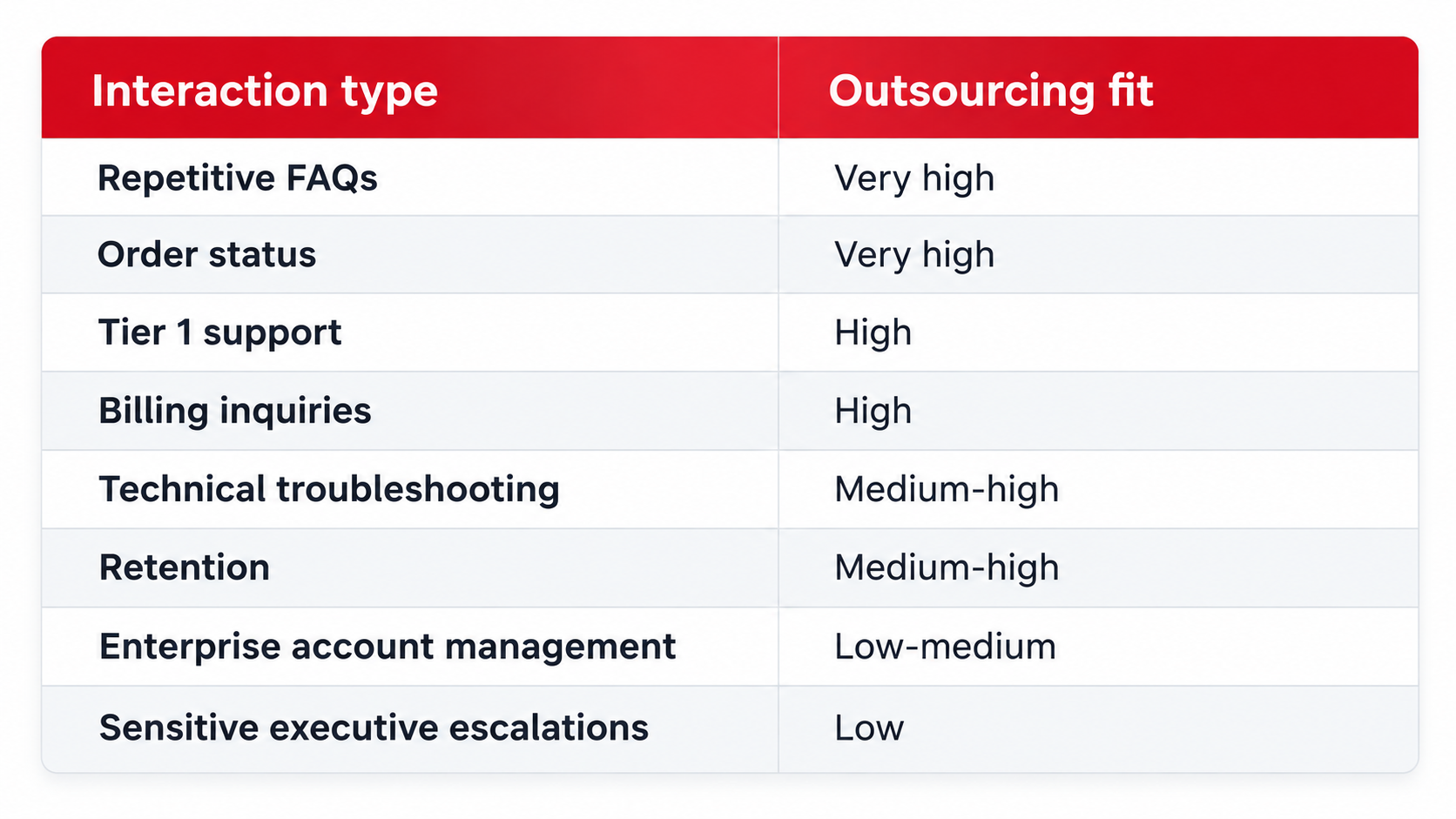
The more standardized and documented the process, the easier it generally is to outsource effectively.
How much does customer service outsourcing cost?
There is no standard outsourcing rate because pricing varies based on several operational and business factors, including:
- Delivery country
- Language requirements
- Agent experience
- Complexity
- Hours of operation
- Dedicated vs. shared staffing
- Service levels
- Technology requirements
- Compliance requirements
Clutch's August 2026 pricing guide reports that customer support outsourcing companies on its platform commonly charge $25–$49 per hour, though rates vary significantly by delivery location and engagement model. Nearshore and offshore programs may run below U.S. onshore rates.
Rather than comparing hourly prices alone, companies should calculate total cost per resolved interaction. Our complete guide to customer service outsourcing costs explains that calculation in more detail.
What are the main customer service outsourcing pricing models?
Common structures include:
- Per agent or FTE
- Hourly
- Per minute
- Per interaction
- Per resolved case
- Fixed monthly fee
- Outcome-based pricing
- Hybrid pricing
Each model creates different incentives. Hourly pricing rewards capacity, for instance, while per-resolution pricing shifts more attention toward completed outcomes. See our full breakdown of customer service outsourcing pricing models.
What are the benefits of outsourcing customer service?
The strongest business cases typically involve five areas.
Faster scalability
Instead of recruiting every new agent internally, companies can add capacity through an established operation.
More flexible costs
Infrastructure, recruiting and workforce management become part of the outsourcing model rather than separate internal investments.
Extended coverage
Providers can support evenings, weekends or 24/7 operations more efficiently than many internal teams.
Specialized expertise
Experienced contact center providers already have QA, workforce management, training and operational systems in place.
Access to technology
Outsourcing can also open the door to omnichannel platforms, analytics and automation without requiring every capability to be built in-house.
What are the risks?
Customer service outsourcing can fall short when companies treat vendor selection as a simple price comparison.
Common risks include:
- Poor brand alignment
- Weak product knowledge
- Inadequate security
- Unclear escalation processes
- Inconsistent quality
- Hidden commercial charges
- Poor reporting
- Misaligned incentives
These risks are exactly why companies should evaluate operational controls, security and governance before choosing a provider. ISO 18295-1, for example, sets requirements for both in-house and outsourced customer contact centers and specifically addresses service delivery and performance management.
When does outsourcing make sense?
Customer service outsourcing becomes especially attractive when:
- Support demand is growing faster than hiring
- Customer volume is seasonal
- 24/7 coverage is becoming necessary
- Labor costs are increasing
- Multilingual support is required
- Customer service technology needs modernization
- Managers spend too much time on staffing instead of CX strategy
Read when a company should outsource customer service for a complete decision framework.
The bottom line
Customer service outsourcing delivers the greatest value when treated as a strategic operating model rather than a labor-cost reduction tactic.
Companies should weigh total cost, customer experience, technology, scalability, security and management capability together. The right partner should not simply provide agents - whether you call it outsourced customer service or customer care outsourcing, it should give your organization the people, processes, and technology needed to deliver customer service consistently as demand changes.
Pentafon combines customer care operations with omnichannel technology, analytics and automation for companies looking to build scalable customer experience operations.
Explore our customer service solutions or contact Pentafon USA to discuss your operation.