


Customer service outsourcing costs can range dramatically depending on where the operation is located, how agents are assigned, which channels they handle and how the contract is priced. So how much does it cost to outsource customer service in 2026? The honest answer: it depends – but there’s a right way to compare quotes.
A useful comparison isn’t simply hourly rate vs. employee salary. Businesses should compare the fully loaded cost of delivering and resolving customer interactions.
Clutch currently reports average customer service outsourcing company rates of approximately $25–$49 per hour on its marketplace, while published nearshore and offshore benchmarks can run substantially lower.
What determines customer service outsourcing cost?
Seven variables usually drive the quote.
Delivery location
Customer service may be delivered onshore, nearshore or offshore. In general:
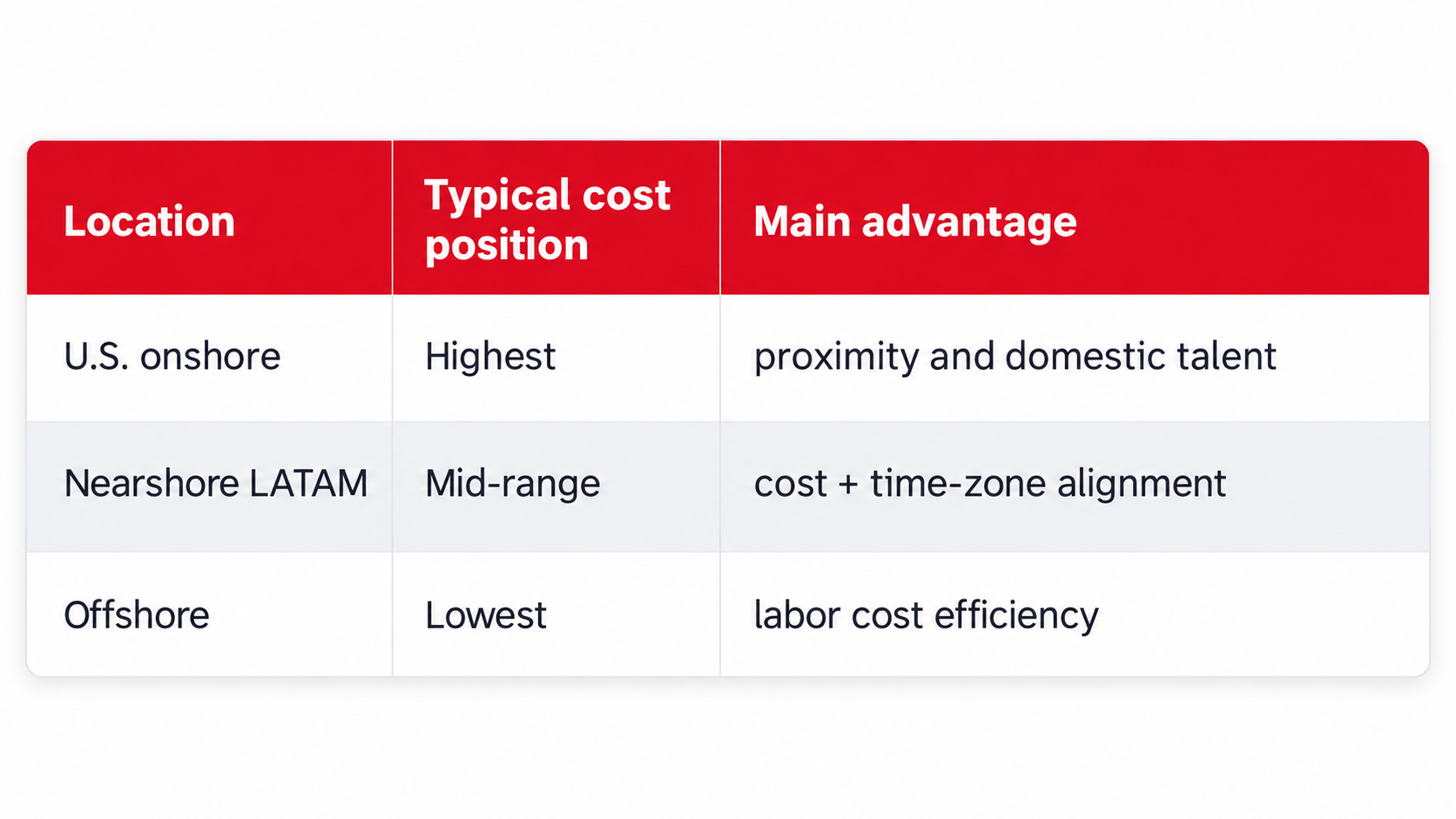
Location should never be evaluated on price alone. Language capabilities, attrition, management access, infrastructure, cultural alignment and first-contact resolution all factor into the real cost.
Dedicated vs. shared agents
A dedicated agent works primarily on your account and develops deeper product knowledge. Shared agents support several clients and can be cost-effective for low or unpredictable volumes.
Interaction complexity
An order-status request and a 30-minute technical troubleshooting call shouldn’t carry the same economics. Complexity affects:
- Training
- Agent profile
- Handle time
- Escalation volume
- Quality monitoring
Service hours
Business-hours support costs less to staff than 24/7 coverage, which requires overnight, weekend and holiday schedules.
Channels
Voice is generally more labor-intensive than asynchronous channels like email. Omnichannel operations add value but also require technology and integration.
Technology
CRM integration, AI, QA systems, workforce management and analytics may be bundled into the rate or charged separately. Pentafon's CX Technology, for example, integrates omnichannel capabilities, speech and text analytics, AI and automation with customer experience operations.
Security and compliance
Operations handling financial or personally identifiable information may require additional controls, certifications and secure infrastructure.
Hidden costs to look for
The quoted rate is not always the final cost. Before comparing proposals, ask whether the following are included:
- Recruiting
- Initial training
- Replacement training
- Supervisors
- QA
- Workforce management
- Software licenses
- Telecom
- Reporting
- Integrations
- Setup fees
- Overtime
- Holiday coverage
- Minimum-volume commitments
A lower hourly quote with several add-ons can become more expensive than a higher, all-inclusive rate.
Compare cost per resolution—not just cost per hour
Say Provider A charges $15 per hour and Provider B charges $18. Provider A looks cheaper.
But suppose Provider A resolves four customer issues per hour while Provider B resolves six. The economics look like this:
Provider A: $15 ÷ 4 = $3.75 per resolved contact
Provider B: $18 ÷ 6 = $3.00 per resolved contact
Provider B is 20% more expensive per agent-hour but 20% cheaper per resolution.
That is why procurement teams should track:
Total CX cost ÷ successfully resolved interactions
alongside the quoted rate.
Outsourcing cost vs. in-house cost
Internal customer service carries expenses that are frequently left out from simple salary comparisons.
They can include:
- Compensation
- Benefits
- Recruiting
- Turnover
- HR
- Training
- Supervisors
- Facilities
- Software
- Telecom
- Security
- QA
- Workforce management
For perspective, the U.S. Bureau of Labor Statistics reported that benefits made up roughly 30% of total private-industry employee compensation costs in March 2026. That does not mean every customer service employee carries the same cost, but it shows why base wages alone are an incomplete benchmark.
Our in-house vs. outsourced customer service comparison covers the full build-vs.-buy decision.
How can companies reduce outsourcing costs without reducing quality?
Focus on productivity rather than simply negotiating down the agent rate. Five levers have the greatest impact:
- Improve the knowledge base.
- Automate simple requests.
- Increase First Contact Resolution.
- Route customers to the right channel.
- Match the pricing model to demand.
A higher-performing operation can reduce cost per resolution even when agent rates stay the same.
Is nearshore outsourcing cheaper?
For many U.S. companies, yes. Mexico is particularly attractive because it combines lower operating costs with proximity and overlapping U.S. time zones.
Published 2026 market guides generally place nearshore Latin American rates below comparable U.S. onshore programs, though actual pricing depends on scope and complexity. Learn more in our guide to nearshore customer service outsourcing in Mexico.
The bottom line
The cheapest customer service outsourcing quote is not necessarily the lowest-cost operation. Compare providers on:
- Total monthly spend
- Cost per interaction
- Cost per resolution
- FCR
- CSAT
- Scalability
- Management overhead
- Technology
- Security
The objective should be to build a lower cost-to-serve, not simply purchase cheaper labor.