


Customer service outsourcing can be priced by the hour, by agent, by interaction, by resolution, as a fixed fee or by business outcome.
No pricing model is universally best. The right structure depends on volume predictability, complexity and how much commercial risk each side should carry.
The main pricing models
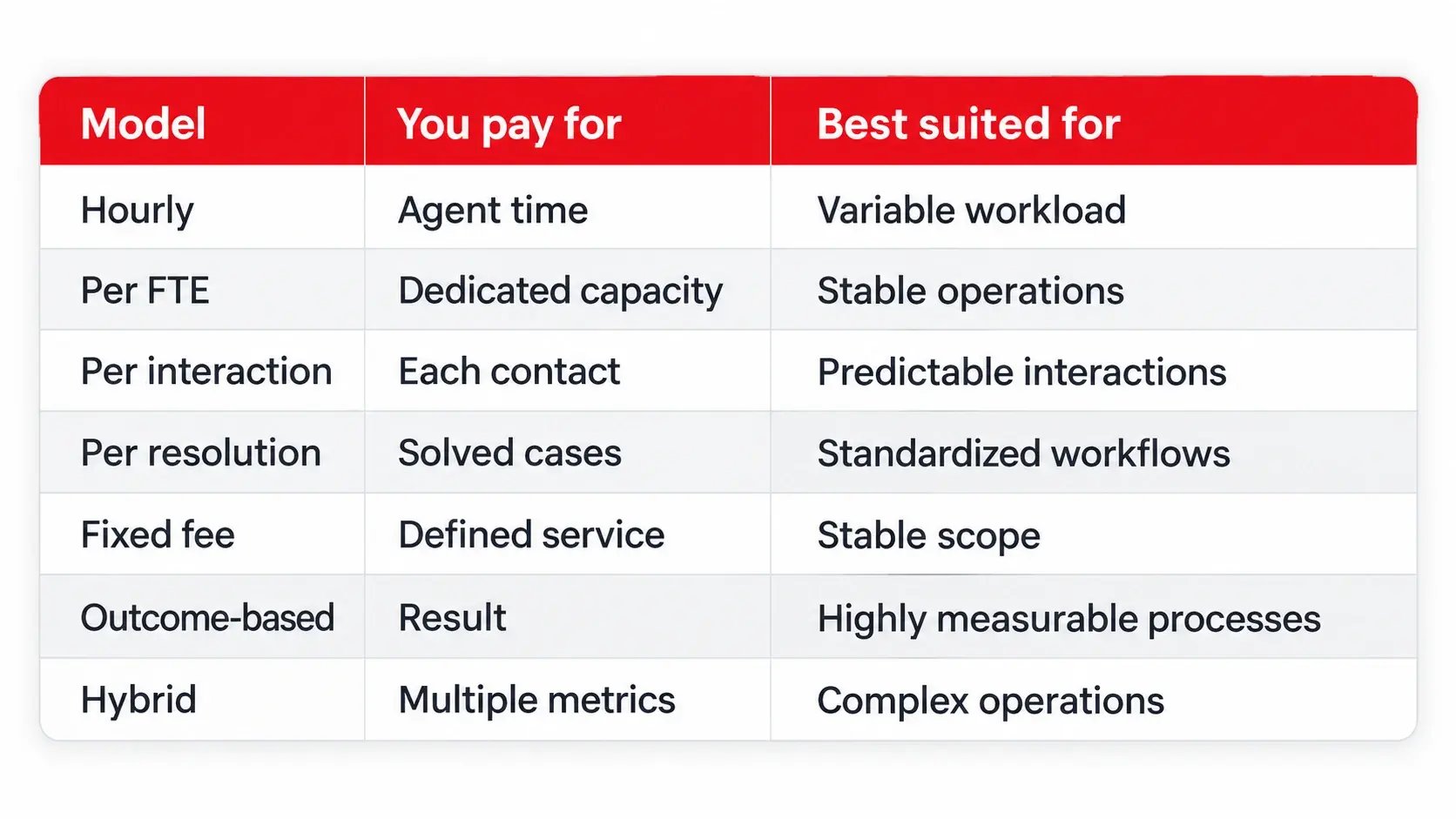
Hourly pricing
You pay for the hours used.
Advantages
- Simple
- Transparent
- Easy to forecast
Risk The provider is paid for time rather than productivity.
Per-agent or FTE pricing
The company pays for dedicated staffing capacity. This works well when agents need substantial product knowledge and volumes are stable. It also gives companies a clearer sense of team ownership.
Per-interaction pricing
The customer pays for each call, email, chat or ticket. This can be effective for highly standardized interactions. However, contracts must clearly define what counts as a billable interaction.
Per-resolution pricing
Payment happens when an issue is successfully resolved. Conceptually, this creates stronger alignment between provider efficiency and client outcomes.
The challenge is defining a "resolution." Does a ticket count as resolved if the customer reaches back out 30 minutes later? Contracts should spell out reopen windows and quality criteria up front.
Fixed-fee pricing
A predictable monthly fee covers an agreed scope. Fixed pricing simplifies budgeting but needs strong volume assumptions. Significant demand swings can make the model inefficient for either the buyer or the provider.
Outcome-based pricing
Some outsourcing relationships tie payment to business results such as:
- Sales
- Retention
- Collections
- Appointments
- Customer satisfaction
These models can create strong alignment when attribution is clear.
Hybrid pricing
Hybrid contracts combine two structures. For example:
Base capacity fee + price per successful resolution
This provides guaranteed staffing while still creating an efficiency incentive.
Pentafon already dives into the narrower question of hourly vs. task-based structures in its article on Hybrid Cost Models in Customer Service, which serves as a supporting page beneath this broader pricing guide.
Which model should you choose?
Use this decision rule:
Predictable volume + complex work → FTE
Variable volume + simple work → per interaction
Standardized and measurable resolution → per resolution
Strong, measurable commercial result → outcome based
Mixed workload → hybrid
Compare incentives, not just rates
The key question is: What behavior does this pricing model reward?
An hourly model rewards available capacity.
A per-contact model rewards throughput.
A per-resolution model rewards closure.
An outcome model rewards results.
Your commercial structure should reinforce the operational behavior you actually want.
For actual market-rate considerations, see our 2026 customer service outsourcing cost guide.