

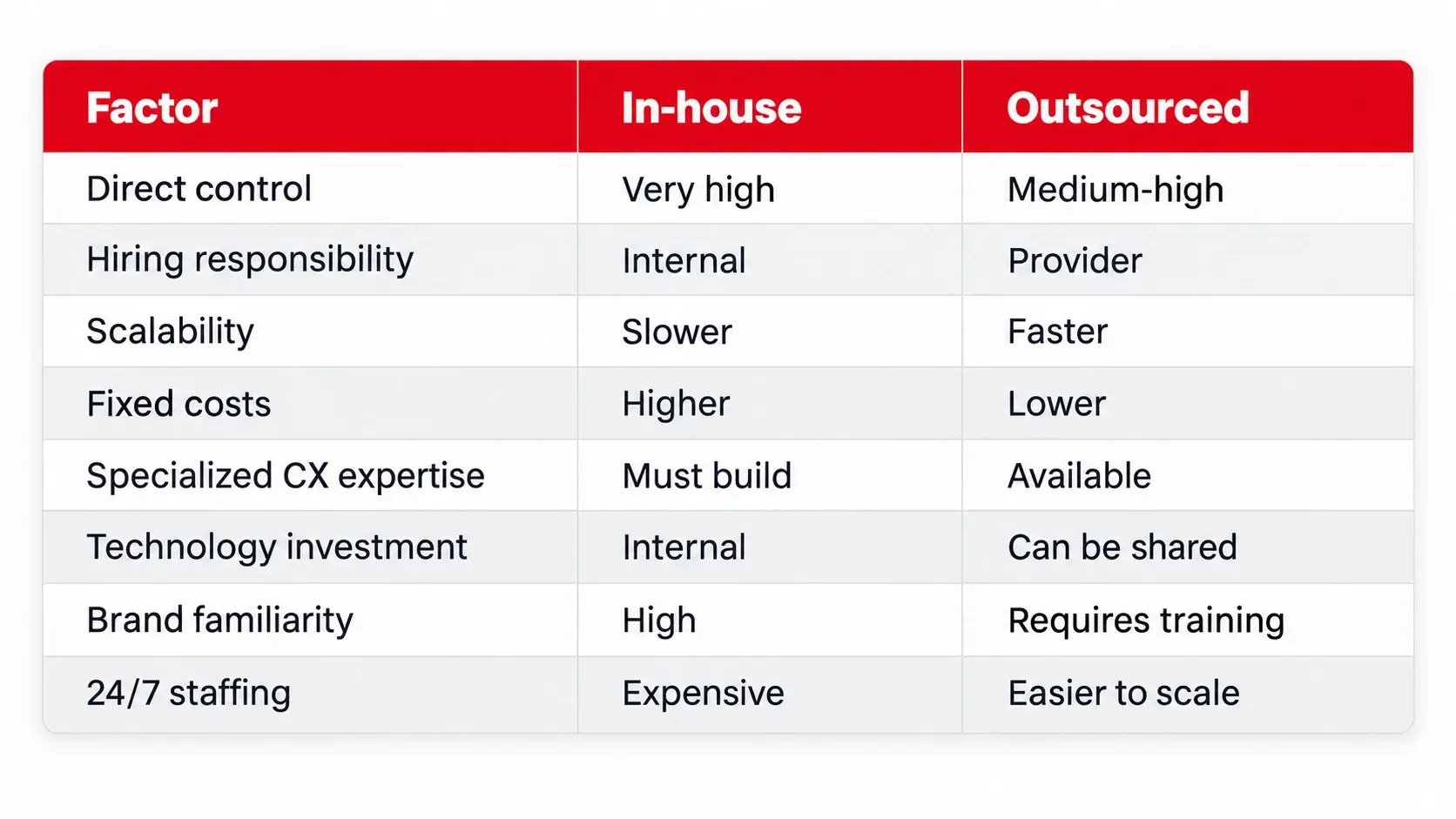
Neither in-house nor outsourced customer service is automatically better. In-house customer service offers maximum direct control. Outsourcing typically offers greater scalability, broader coverage and a more flexible operating structure.
For many companies, the best answer is a hybrid model.
In-house vs outsourced customer service at a glance
When is in-house customer service better?
Keeping customer service internal can make sense when:
- Interaction volume is low
- Support is highly technical
- Customers require specialized institutional knowledge
- Support is strategically tied to product development
- Customer relationships are extremely high value
An early-stage B2B SaaS company with 40 enterprise customers, for example, may get more value by keeping product experts close to clients.
When is outsourcing better?
Outsourcing becomes stronger as operational complexity increases. Typical triggers include:
- Hundreds or thousands of daily interactions
- Rapid growth
- Seasonal peaks
- High recruitment requirements
- 24/7 coverage
- Bilingual support
- Multiple support channels
- Rising cost-to-serve
At that stage, the company is no longer just managing customer conversations. It’s running a workforce management, recruitment, QA, training and technology operation. A specialized provider already has those capabilities.
What about control?
Loss of control is one of the most common concerns about outsourcing. But operational control and employment control are not the same thing.
A company can outsource staffing while retaining control over:
- Policies
- Customer journey
- Scripts
- Escalation rules
- KPIs
- Quality requirements
- Technology
- Brand standards
The outsourcing partner manages execution. This is why governance and reporting matter just as much as the agents themselves.
What is a hybrid customer service model?
A hybrid operation divides work between internal and outsourced teams. For example:
Internal team
- VIP customers
- Escalations
- Product feedback
- Complex retention cases
- Tier 1 support
- Order tracking
- Billing questions
- Live chat
- Weekend coverage
Outsourced team
- Tier 1 support
- Order tracking
- Billing questions
- Live chat
- Weekend coverage
Which model costs less?
Outsourcing often reduces the fixed infrastructure and management burden that comes with running large support operations. That said, companies should compare fully loaded costs.
An internal agent requires more than salary - recruiting, benefits, supervisors, technology and turnover all add cost. See our 2026 customer service outsourcing cost guide before making the comparison.
Which delivers better customer experience?
Either model can deliver excellent—or poor—CX. The operating model matters more than the employment model.
Strong customer service requires:
- Good training
- Accurate knowledge
- Clear processes
- Useful technology
- Quality monitoring
- Fast escalation
- Employee engagement
Pentafon combines trained customer care teams with omnichannel customer service solutions and CX technology to support these capabilities at scale.
Final decision
Choose in-house when deep institutional knowledge and direct control are more important than scalability.
Choose outsourcing when volume, coverage, recruiting or cost complexity is becoming difficult to manage internally.
Choose a hybrid model when you need both.
If your internal organization is reaching its operational limits, our guide to when companies should outsource customer service can help you identify the tipping point.